Minister (&/vs.) Preacher (&/vs.) Priest

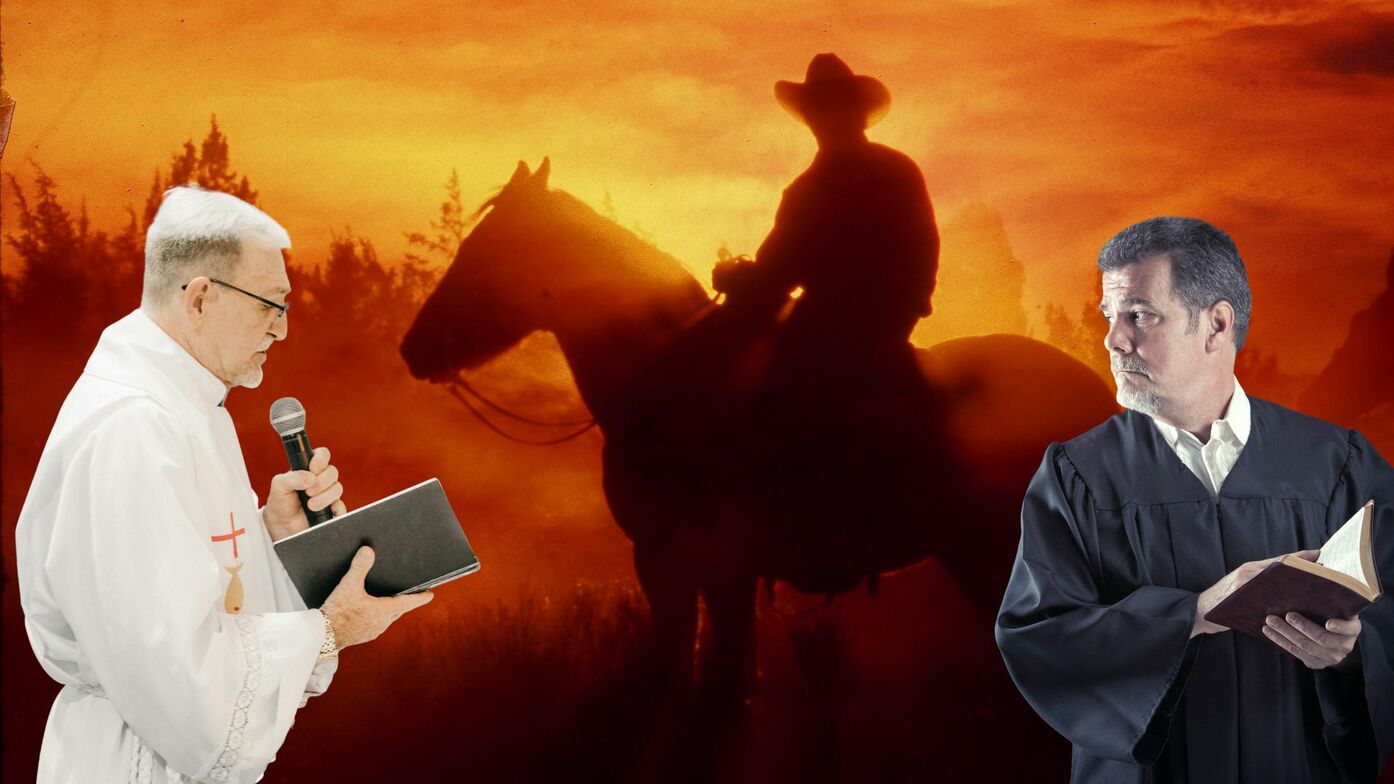
“So, a priest, a minister, and a preacher walked into a McDonald’s one day…”
This could be the beginning of a good joke, or the entry point to a very brief discussion about what, if any, differences there are between these three titles. If they all are leaders in a local church, bound to the Words of Scripture, why would we call them different names? After all, they apparently all enjoy an occasional Big Mac.
Minister:
The word “minister” is a term that was once in vogue, colloquially, but is not as prominent nowadays. It is a generic term that refers to a leader of a local church. Some churches have prominent members that are formally referred to as ministers. There are many times in the New Testament, where the Greek word dulos is translated as “minister.”
Of this gospel I was made a minister according to the gift of God's grace, ... (Ephesians 3:7)
The primary meaning behind the Greek root word dulos, is “servant.” A servant, in this modern age, is someone who administers relief to a particular need. If you need/want a coffee, then a servant will administer a coffee to you (for a price, of course). The act of administering a service to a person is shortened to the verb “minister.”
For example: Mr. Whiteacre is at home with an illness. Knowing this, Mr. Brownacre will endeavor to minister to Mr. Whiteacre’s needs. Maybe a can of chicken soup.
The New Testament uses minister both as a verb and a noun – in most cases, tied to the main Greek root word for serve or servant. Therefore, the title “minister,” is a word that, in its biblical context, closely retains the original sense of servanthood.
Of the three titles we are examining, minister seems to carry the most humility. It is also the broadest of the three terms. For instance, the Internal Revenue Service gives special recognition to a person who is ordained as a “minister.” Under the umbrella of this broad definition, a minister is one who administers rites or sacraments.
Priest:
A priest is a title that is unique to churches that are formal and liturgical. Among the churches that have priests are the Roman Catholic and Eastern Orthodox Churches. The more ancient and structured the church organization and service are, the more likely you will be to find a priest.
Priests draw their roots from the Old Testament, where we see priests who were specifically appointed by God to offer sacrifices and perform service to God in the tabernacle and temple. Even before that service, we see Melchizedek, who is described as a priest and king.
And Melchizedek king of Salem brought out bread and wine. (He was priest of God Most High.) Genesis 14:18
Priests are narrowly defined in their church function by structural design and historical precedent. Our minds think of priests as wearing robes while leading a formal and solemn liturgical service. If that is where your mind has set its imagery, then your mind is not far from a general understanding of the term.
Preacher:
A preacher is another term that has fallen out of popular usage within the church and society. When I think of a preacher, I go back to the 1985 Western movie, Pale Rider, where the movie concludes with a young lady calling out for the gun slinging Clint Eastwood, using his title “Preacher!” In our modern culture, a preacher is often associated with images of a sweaty impassioned man, delivering an emotional message while shaking a Bible.
A preacher is mentioned four times in the New Testament (Romans 10:14, 1 Timothy 2:7, 2 Timothy 1:11, and 2 Peter 2:5 [in the KJV]). Each time, the title is a derivative of the same Greek verb, kaeruso, which means to proclaim. It is not a far leap, then, to see that a preacher fulfills a role as one who proclaims the Word of God. Paul refers to himself, in the letters to Timothy, as a preacher, apostle, and teacher.
The common term to use for a Protestant church leader who preaches is “pastor.” Some larger churches will have preaching pastors, as well as executive pastors, counseling pastors, and pastors who serve other primary functions. In a clear majority of Protestant churches, the preacher is the pastor, and the pastor is an elder who is called to shepherd of the local congregation. He just so happens to be the one who preaches nearly every week.
What about me?
Biblically and historically speaking, a priest is one who approaches and speaks with God on behalf of man. We are all called to be priests – we intercede for each other day and night.
you yourselves like living stones are being built up as a spiritual house, to be a holy priesthood, to offer spiritual sacrifices acceptable to God through Jesus Christ. (1 Peter 2:5)
Biblically speaking, a minister is one who aids the administration of God’s message and goodness to a needy world. The New Testament says we are all ministers, especially when we consider the aspect of ministry that encapsulates servanthood.
As each has received a gift, use it to serve one another, as good stewards of God's varied grace: whoever speaks, as one who speaks oracles of God; whoever serves [ministers], as one who serves [ministers] by the strength that God supplies—in order that in everything God may be glorified through Jesus Christ. To him belong glory and dominion forever and ever. Amen. 1 Peter 4:10-11
Finally, the New Testament says we are all called to proclaim the Gospel of Jesus, thereby we are all to preach.
How then will they call on him in whom they have not believed? And how are they to believe in him of whom they have never heard? And how are they to hear without someone preaching? 10:14
So, as it turns out, those three titles that walked into McDonald’s are all worn by the same person – you, the disciple of Jesus!